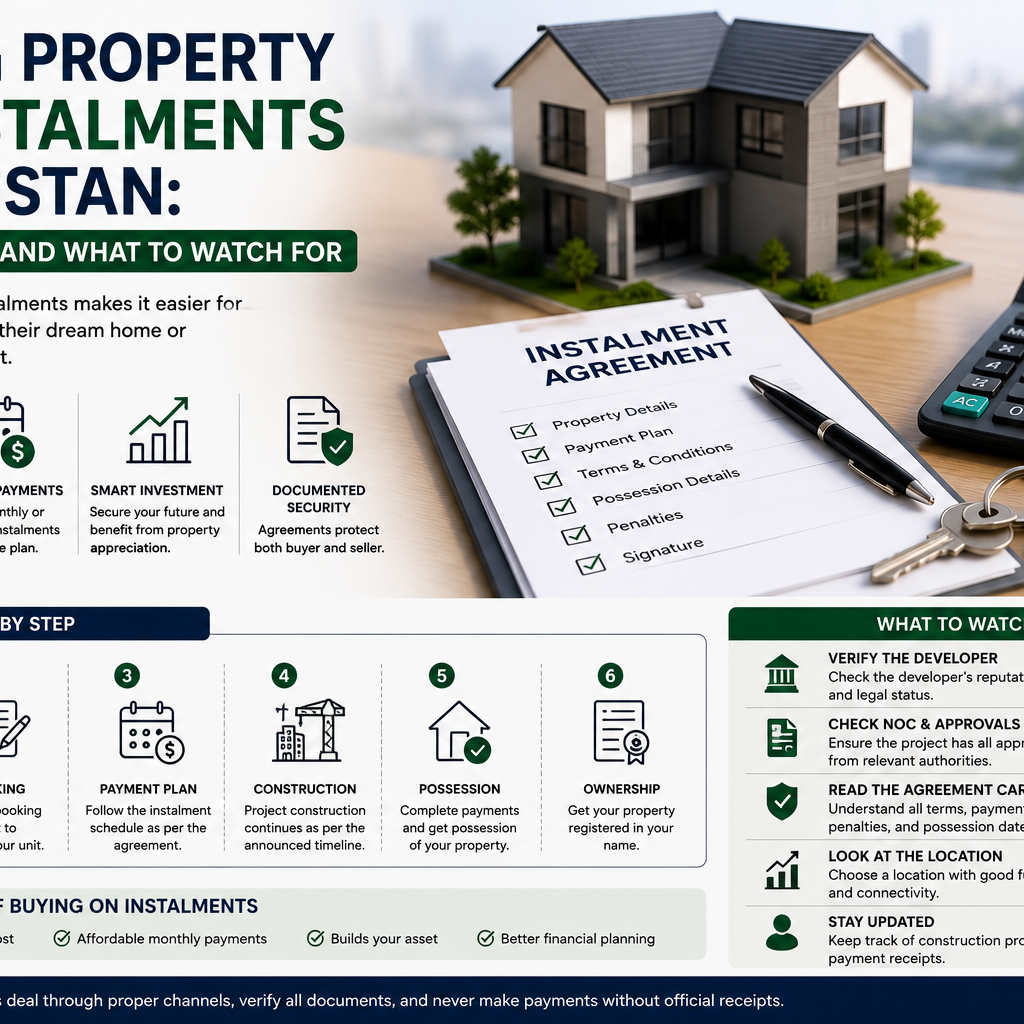
Buying Property on Instalments in Pakistan: How It Works and What to Watch For
Not everyone can pay for a plot or house in one go. For many buyers in Pakistan, instalment plans are the only realistic way into the property market. You pay a portion up front, then spread the rest over months or years.
The idea is sound. Instalments let ordinary earners buy property they could never afford in a single payment. But these plans also carry risks that catch people out, especially first-time buyers. This guide explains how instalment buying works, where the dangers hide, and how to protect yourself.
How instalment plans usually work
Most instalment deals follow a similar shape. You start with a booking amount which is sometimes called a down payment. It secures the plot or unit. After payment of down payment you pay regular instalments usually monthly or quarterly until the full price paid.
Some plans spread the cost evenly. Others ask for larger lump sums at certain points, often linked to stages of development or possession. These bigger payments can catch a buyer who only budgeted for the small monthly amounts, so read the schedule in full before signing.
The total you pay through instalments is often higher than the cash price. Sellers build in a cost for waiting on their money. Compare the instalment total with the cash price so you know exactly what the convenience is costing you.
Where instalment plans are common
Instalment buying shows up most in new housing societies and developer projects. A society launching a fresh phase will often sell plots on easy instalments to attract early buyers.
Developers building flats and apartment blocks use the same approach. You book a unit during construction and pay in stages as the building rises. By the time it is finished, much of the price is already paid.
Resale property, by contrast, is usually a cash deal between two private parties. Instalment arrangements there are rarer and need careful handling, because there is no developer guaranteeing the plan.
Confirm the project is genuine first
Before you fall in love with an easy payment plan, check that the project behind it is real and approved.
A low booking amount and a long instalment schedule mean nothing if the society is illegal or the developer never finishes the building. Confirm that the scheme is approved by the relevant development authority and that the specific phase or block is sanctioned. For an apartment project, check the developer's track record and whether they have completed past projects on time.
The instalment plan is only as safe as the people offering it. A genuine, approved project is worth committing to. A risky one can take your instalments for years and deliver nothing.
Understand the difference between a file and a confirmed plot
In many instalment schemes, especially early ones, you are buying a file rather than a fixed, allotted plot.
A file is a claim on a plot that may be assigned to you later, once development reaches that stage. A confirmed plot has a specific number and location. The difference matters. A file carries more uncertainty, because the society controls when and where your plot lands.
Ask clearly what you are buying. If it is a file, understand the risk. If it is a confirmed plot, get the plot number and location in writing. Vague promises about future allocation have disappointed many buyers.
Read the payment schedule carefully
The schedule is the heart of the deal, so study it line by line.
Note the booking amount, the size of each instalment, and how often they fall due. Look for any larger payments built into the plan, such as confirmation charges, development charges, or possession instalments. These extras can arrive at awkward moments.
Work out the full picture across the whole term. Add up every payment, including the booking and any lump sums, so you know the real total. Then ask yourself honestly whether you can keep up for the entire length of the plan, not just the first year.
Know what happens if you miss a payment
This is the question most buyers forget to ask, and it can be the most painful.
Find out the penalty for a late or missed instalment. Many plans charge a surcharge on delayed payments. Some allow a grace period. Others are stricter. In serious cases, repeated default can lead to the cancellation of your booking.
Ask what happens to the money you have already paid if your booking is cancelled. Some schemes refund it after deductions. Others keep a large share. A few return very little. Knowing this before you commit tells you exactly how much risk you carry if your circumstances change.
Check the link between payment and possession
Paying your instalments does not always mean you can take possession or build straight away.
In many schemes, possession comes only after development reaches your plot, or after you have paid a certain share of the price. You might finish a chunk of the instalments and still be waiting for a livable, buildable plot. Understand this timeline before you buy, especially if you need the property soon.
For apartments you should confirm when the unit will be ready and what protection you have if construction runs late. Delays are common, so a clear completion commitment in writing is valuable.
Get every promise in writing
Verbal assurances are worth little once a dispute begins. Insist on a written agreement that captures the whole deal.
The agreement should state the total price, the booking amount, the full instalment schedule, the penalties for default, and the refund terms if the booking is cancelled. It should also record what you are buying, whether a file or a confirmed plot, and when possession is due.
Read every clause before signing. If something the salesperson told you is not in the document, ask for it to be added. Keep a signed copy and every payment receipt in a safe file.
Watch the transfer position during instalments
A property bought on instalments is often not fully transferable until the price is cleared.
In many schemes, the society or developer holds the property in their record until you complete payment. Only then do they transfer full ownership to you. This means that during the instalment period, your claim rests on the agreement and the receipts, not on a completed transfer.
Confirm how and when the final transfer happens. Keep proof of every payment, because those receipts are your evidence of what you have paid. Without them, proving your stake becomes difficult.
Think about reselling before you finish paying
Many buyers sell their plot or file before completing the instalments, hoping to make a profit on the way. This is common, but it has rules.
Ask whether the scheme allows transfer of a file or partly-paid plot to another buyer, and what charges apply. Some societies permit it freely. Others restrict it or charge a fee. If reselling is part of your plan, confirm it is allowed before you book.
Be realistic about demand too. A file only sells at a profit if other buyers want into the scheme. In a weak market, or a society that loses its shine, you may struggle to find a buyer at all.
Compare instalments with other options
Before settling on an instalment plan, weigh it against the alternatives.
Could you save for a little longer and buy a cheaper property in cash, avoiding the extra cost of instalments? Could a bank home loan work out better for your situation? Each route has its own cost and its own risk. An instalment plan from a developer is not automatically the cheapest or the safest, even if it feels the easiest.
Run the numbers in your own situation. The right answer depends on your income, your timeline, and how much risk you can carry.
Judge the developer or society behind the plan
An instalment plan is a long relationship. You are tied to the developer or society for the length of the schedule, so their reliability matters more than the offer itself.
Look at what they have completed before. A society or developer with finished projects, real possession handed over, and satisfied buyers is a safer bet than one with only promises and brochures. Visit their earlier schemes if you can. See whether the roads, parks, and services they promised actually exist. A track record on the ground tells you far more than any sales pitch.
Be cautious with brand-new entrants offering unusually generous terms. Very easy payments and very low booking amounts can be a way to pull in cash quickly. Some genuine developers do offer good launch deals, but the only way to tell is to check who is behind the project and what they have delivered before.
Match the instalments to your income
An instalment plan only works if you can pay it through to the end, in good times and bad.
Before committing, look honestly at your income and how steady it is. An instalment that feels comfortable today can become a burden if your earnings dip or an unexpected expense lands. Leave yourself a margin. Do not commit to the largest plan you can just about manage, because life rarely runs in a straight line.
Think about the full length of the schedule too. A plan that runs for several years asks a lot of your future self. Make sure the commitment fits not just your current situation, but a realistic view of the years ahead.
Keep a clear record of every payment
With instalment buying, your receipts are your proof of ownership until the final transfer. Treat them accordingly.
Keep every receipt in a single file, in order, with dates. Note the date, the amount, and what it covered. If you ever face a dispute over how much you have paid, this file is your evidence. Buyers who lose track of their receipts put themselves in a weak position, because the burden of proof often falls on them. A few minutes of record-keeping after each payment protects everything you have put in.
Common mistakes to avoid
A few errors come up again and again with instalment buying.
The first is budgeting only for the small monthly amounts and forgetting the larger lump sums in the plan. The second is booking in an unapproved or unproven scheme tempted by an easy payment offer. The third is failing to keep receipts, which leaves a buyer unable to prove what they paid. The fourth is ignoring the default and refund terms until it is too late.
Each of these is avoidable with a little care up front. None is easy to fix afterwards.
Final thoughts
Instalment buying has opened the property market to people who could never pay in one lump sum, and that is a real benefit. Used wisely, it turns a distant goal into a reachable one. Used carelessly, it can trap a buyer in payments for a property that never materialises.
Protect yourself by checking that the project is genuine and approved. Understand exactly what you are buying, read the full payment schedule, and know the penalties before you commit. Keep every receipt, get every promise in writing, and never stretch your budget to a point you cannot sustain.
Do all of that, and an instalment plan becomes a sensible path to owning property. Skip it, and the easy monthly payment can turn into a long and expensive regret.