Bagh e Jinnah (Lawrence Gardens): A Historic Garden of Lahore
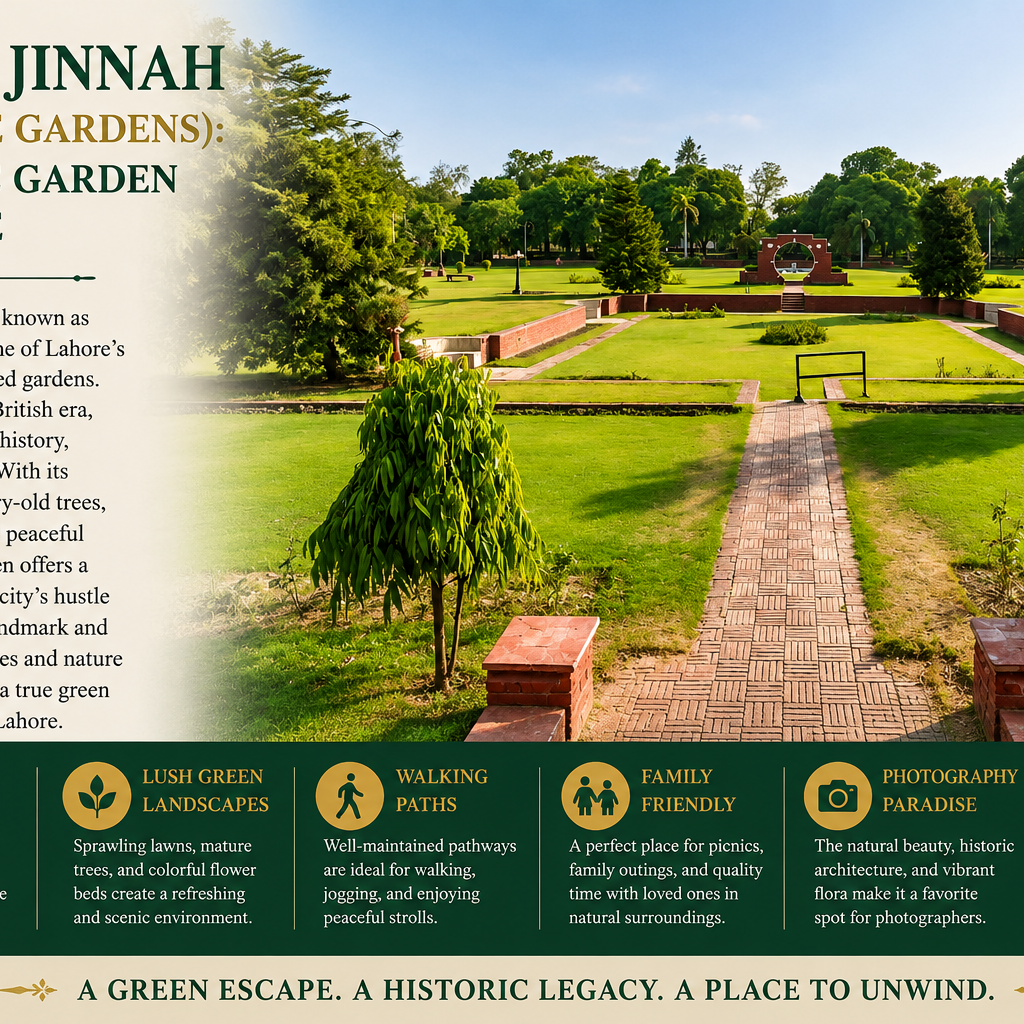
Bagh e Jinnah is situated on Mall road in the heart of Lahore and next to the Lahore Zoo. It is one of the oldest and most beautiful gardens in the city. The British laid it out in 1862 as Lawrence Gardens, a botanical garden modelled on the famous Kew Gardens in London. It holds a rich collection of rare trees and plants, along with the grand Quaid e Azam Library. It was renamed after Muhammad Ali Jinnah at the creation of the country. For anyone getting to know Lahore, Bagh e Jinnah is a green sanctuary where colonial history meets botanical beauty.
This guide explains what Bagh e Jinnah is, its history, its attractions and its setting in the city. It covers both the gardens themselves and the landmarks within them.
Bagh e Jinnah
Bagh e Jinnah is a historic public park in the heart of Lahore. It was formerly known as Lawrence Gardens. The name means the Garden of Jinnah, in honour of the founder of the country. The park is situated on The Mall, on Lawrence Road, next to the Lahore Zoo and directly across from the Governor's House. It is one of the most cherished green spaces in the city.
The park is above all a great botanical garden. It was laid out as a botanical garden modelled on the Royal Botanic Gardens at Kew in London. It holds a remarkable collection of plants across its grounds. It has around 150 varieties of trees, 140 types of shrubs, 50 types of creepers, 30 palms and many succulents and flowers. Some of its trees date back to the colonial era and have grown into vast, shady canopies. This wealth of plant life makes the park a living museum of horticulture.
The park holds several notable landmarks within its grounds. The grandest is the Quaid e Azam Library, housed in a Victorian building. The park also contains the Masjid Dar ul Islam, a mosque. It holds the shrine of a saint known as Baba Turat Muraad Shah too. There is an open air theatre, a restaurant, tennis courts and the historic Bagh e Jinnah Cricket Ground. These landmarks add cultural and recreational richness to the botanical beauty of the park.
The park now spreads across around 141 acres. It was originally larger. Parts of the land were given over to the Lahore Zoo and other development. It is managed by the Parks and Horticulture Authority. The park is famous for its chrysanthemum shows, being the first institution in the region to grow the flower in many varieties. It remains one of the most beautiful and historic gardens in the city.
Quick answer: Bagh e Jinnah, formerly Lawrence Gardens, is a historic botanical garden on The Mall in Lahore, next to the Lahore Zoo. The British laid it out in 1862, modelled on Kew Gardens in London. It holds a rich collection of rare trees and plants, along with the Quaid e Azam Library. It was renamed after Muhammad Ali Jinnah.
History of the gardens
The history of Bagh e Jinnah reaches back to the early years of British rule in Lahore. The site was originally occupied by the Agri Horticultural Society of Punjab. It had been planned as a botanical garden. By 1860, the first part of the gardens had been laid out. The site had been a wilderness, partly used as a menagerie and partly as a pleasure ground for sports such as badminton, archery and cricket.
The gardens took shape in the 1860s. The first tree was planted in the garden in January 1862. That same year, the Lawrence Hall was constructed for public meetings and theatrical entertainment. The gardens were laid out in a formal design, with geometric paths, axial routes and carefully chosen plantings. This design followed the model of Kew Gardens and other colonial gardens, bringing a European sense of order to the site.
The gardens were named after a British figure. They were named after John Lawrence, who served as the Lieutenant Governor of Punjab and later became the Viceroy of India from 1864 to 1869. The gardens served as a pleasure ground and a place of botanical experiment for the British elite of the city. A statue of Lawrence once stood in the area. The Montgomery Hall, named after another governor, was built alongside the Lawrence Hall.
The gardens were renamed after the creation of the country. Following the partition of 1947, Lawrence Gardens was renamed Bagh e Jinnah in honour of Muhammad Ali Jinnah, the founder of the country. The statue of Lawrence was removed and later moved abroad. The renaming reflected the transition of the public spaces of the city from the colonial era to the new nation. The gardens have continued to serve the public ever since, evolving from an elite pleasure ground into a democratic green space for everyone.
The Quaid e Azam Library
The Quaid e Azam Library is the crowning landmark of Bagh e Jinnah. It is a public library housed in a grand Victorian building at the heart of the gardens. The building is one of the finest examples of Victorian architecture in the region. It gives the park a strong cultural and educational character alongside its botanical beauty.
The building has a rich history of its own. It was built in the mid nineteenth century, around 1866. It consists of the Lawrence and Montgomery Halls. These were built in memory of two governors of Punjab. The building originally served as a hall for public meetings and entertainment and later as the home of the Lahore Gymkhana Club. It was built in the neoclassical style, at a cost contributed by the public and the government of the time.
The building was converted into a library in the 1980s. The halls were repurposed as the Quaid e Azam Library. It was officially inaugurated in December 1984. The library was named in honour of the founder of the country. This gave the historic building a new life as a centre of learning and research. The conversion preserved the grand Victorian architecture while giving it a public purpose.
The library is a major public resource today. It holds a large collection of books, put at over 125,000 volumes, in English, Urdu, Arabic and Persian. It has thousands of members and adds new books each year. The library has been expanded with additional reading space in recent years. It offers a computer lab, reference materials and a room for those preparing for competitive examinations. This makes the library a vital centre for students, scholars and researchers.
Gardens and attractions
The gardens are the heart of Bagh e Jinnah and its greatest treasure. The park is a rich botanical garden, home to a large collection of native and exotic plants. The gardens are divided into themed sections in which each showing different types of plants and styles of planting. This variety makes the gardens a place of constant interest and beauty.
The collection of trees in Bagh e Jinnah specially in these gardens is especially remarkable. The gardens hold a rich collection of rare trees and shrubs, both indigenous and exotic, with thousands of trees in all. These include banyans, keekars, shishams, pipals, oaks and camphor trees. Many of these date from the colonial era and have grown into vast, shady canopies. These old trees give the gardens their timeless and majestic character. A training centre for floriculture and landscaping supports the care of the collection.
The park is famous for its flower shows. It has a great name in chrysanthemum shows, being the first institution in the region to grow the flower and to develop many varieties. These shows draw visitors from across the city. The gardens are especially beautiful in the flowering seasons, when the beds and borders come into full colour. The park also holds nurseries and greenhouses that support its horticultural work.
The park offers recreation and sport alongside its gardens. The historic Bagh e Jinnah Cricket Ground has a long and famous history. The park also has tennis courts, a football arena, an open air theatre and a restaurant. The Lahore Gymkhana Club, founded in the nineteenth century, offers further sporting facilities.
Cricket ground
The Bagh e Jinnah Cricket Ground holds a special place in the history of cricket in the country. It is one of the oldest cricket grounds in the region. The ground dates back to 1885, when it was built for the entertainment of government officers and civil servants. The Lahore Gymkhana Club held regular fixtures here. This gives the ground a long and storied history.
The ground played an important role in the early years of cricket in the country. It hosted friendly matches and competitive fixtures over the decades. It hosted the first unofficial Test match of the country, against the West Indies in 1948. It later became a full Test venue when the country played India in the 1954 to 1955 season. New Zealand and the West Indies also played Test matches here in this period.
The ground later stepped back from the top level. It lost its Test status as the larger Gaddafi Stadium became the main venue in the city. The Bagh e Jinnah ground still hosts tour matches involving visiting nations, especially England. The old trees that overlook the ground give it a distinctive and beautiful setting. The ground remains a cherished part of the cricketing heritage of the city, set within the historic gardens.
Setting in the city
Bagh e Jinnah is situated in a central part of Lahore on The Mall, the grand avenue of the colonial city. It is situated on Lawrence Road, next to the Lahore Zoo and across from the Governor's House. It is one of the most accessible green spaces in Lahore.
The park lies within a rich cluster of attractions. The Lahore Zoo is right next door, once part of the same gardens. The Jilani Park, the historic Racecourse Park, is a short distance away. The colonial buildings of The Mall, including the Lahore Museum, the General Post Office and the Lahore High Court, are nearby. The Alhamra Arts Council and the Shrine of Shah Jamal are within reach. This places the park at the heart of the cultural and green life of the city.
The setting adds to the value of the park for the city. It provides a large and historic green space in the heart of a busy metropolis. It is a place for morning walks, family picnics, study and quiet reflection. The park has featured in literature and holds a nostalgic place in the memory of the city. It is for this reason that the park plays an integral role in the cultural and social fabric of Lahore.
The park is one of the key elements responsible for making Lahore a Garden City. It reflects the complex history of the city through its combination of Victorian gardens of the colonial period and modern botany. It has evolved from a colonial space of exclusion into a democratic space for everyone. For anyone getting to know Lahore, the park is one of the places that captures both the history and the natural beauty of the city.
Visiting Bagh e Jinnah
Bagh e Jinnah is one of the most rewarding places to visit in Lahore for history and nature. It offers a historic botanical garden, a grand library and recreational facilities in one central space. It suits families, students, nature lovers and those interested in history.
The park is generally open through the day into the evening. Entry to the gardens is generally free, making it an affordable place to visit. The Quaid e Azam Library is open to the public, though reading room access may require registration. The Victorian library building is worth seeing for its architecture. A visit of a couple of hours allows time to stroll the paths, admire the trees and see the main landmarks. Free parking is available at the entrances along The Mall and Lawrence Road.
The park is reached easily as it is situated on The Mall in central Lahore. It is accessible by car, taxi, rickshaw or ride hailing service. Its central location makes it easy to reach from most parts of the city. The Lahore Zoo is right next door, making it easy to combine the two.
The cooler months from around October to March offer a comfortable time to visit, though the park is enjoyable much of the year. The flowering seasons, especially the time of the chrysanthemum shows, are the most beautiful. Early mornings are ideal for walks and exercise. Visitors are asked to respect the gardens, avoid damaging the plants and trees and help keep the park clean. A visit combines well with the Lahore Zoo, the Jilani Park and the colonial landmarks of The Mall.
Places near Bagh e Jinnah
Bagh e Jinnah is situated within reach of many landmarks and useful places in central Lahore. This helps visitors plan a fuller trip. The Lahore Zoo is situated right next door. The Jilani Park, the historic Racecourse Park, is a short distance away. The Governor's House is situated across The Mall. The Alhamra Arts Council and the Shrine of Shah Jamal are within reach.
The colonial buildings of The Mall, including the Lahore Museum, the General Post Office and the Lahore High Court, lie nearby. Anarkali Bazaar is close for shopping and food. Data Darbar, the shrine of Data Ganj Bakhsh, is within reach. The Walled City with the Lahore Fort and the Badshahi Mosque lies a short drive away. The Services Hospital and Mayo Hospital serve the central area. These connections make the park an easy part of a tour of central Lahore.
Frequently asked questions
Where is Bagh e Jinnah located? Bagh e Jinnah is situated on The Mall in central Lahore, on Lawrence Road, next to the Lahore Zoo and across from the Governor's House. It is in a central part of the city and is easily reached from across Lahore.
Why was it called Lawrence Gardens? The gardens were named after John Lawrence, who served as the Lieutenant Governor of Punjab and later as the Viceroy of India from 1864 to 1869. They were laid out in 1862 as a botanical garden and pleasure ground during the British era.
When was it renamed Bagh e Jinnah? The gardens were renamed Bagh e Jinnah after the partition of 1947, in honour of Muhammad Ali Jinnah, the founder of the country. The renaming reflected the transition of the public spaces of the city from the colonial era to the new nation.
What is the Quaid e Azam Library? The Quaid e Azam Library is a public library housed in a grand Victorian building within the gardens, the former Lawrence and Montgomery Halls. It was converted into a library and inaugurated in 1984. It holds over 125,000 books and is a major centre for students and researchers.
What are the main attractions at Bagh e Jinnah? The main attractions include the botanical garden with its rare trees and flower shows, the Quaid e Azam Library, the Masjid Dar ul Islam, the historic cricket ground, tennis courts, an open air theatre and a restaurant. The park is especially famous for its chrysanthemum shows.
Is there an entry fee for Bagh e Jinnah? Entry to the gardens is generally free which makes it an affordable place to visit. The Quaid e Azam Library is open to the public, though reading room access may require registration. Free parking is available at the entrances.
Bagh e Jinnah is one of the great historic gardens of Lahore and a green sanctuary in the heart of the city. Laid out by the British in 1862 as Lawrence Gardens, modelled on the famous Kew Gardens in London, it holds a remarkable collection of rare trees and plants gathered over more than a century and a half. Its old, shady canopies, its flower shows and its themed gardens make it a living museum of horticulture.
The park brings together botanical beauty, colonial history and cultural life in one central space. The grand Quaid e Azam Library, housed in a Victorian building, gives it a place of learning, while its historic cricket ground holds a special place in the sporting heritage of the country. Renamed after the founder of the country at independence, the park has evolved from an elite colonial garden into a democratic green space for everyone. It remains one of the most beautiful and historic gardens in Lahore and a treasured green heart of the city whether you visit Bagh e Jinnah for its trees, its flowers, its library or simply a quiet walk beneath its ancient canopies.