Badshahi Mosque: Guide to the Grand Mughal Mosque
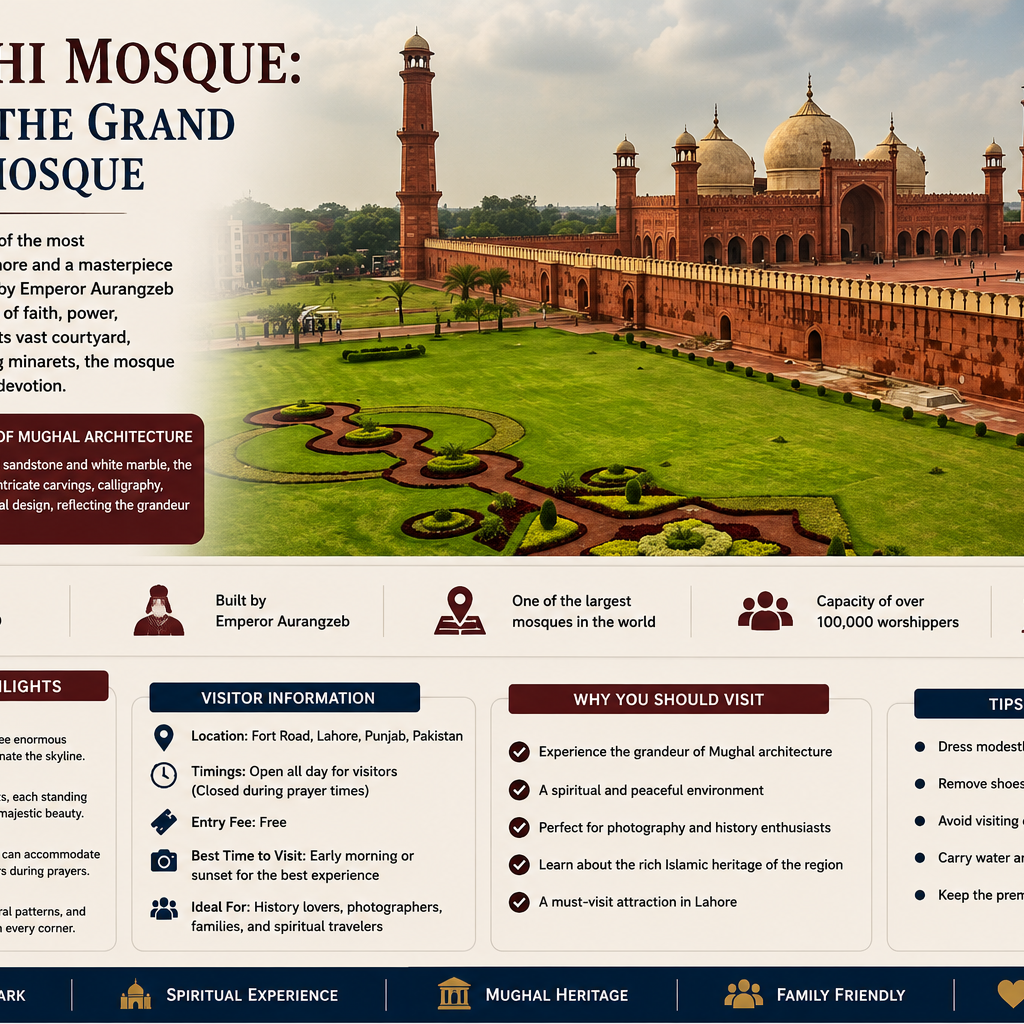
The Badshahi Mosque stand tall in front of Lahore Fort across the Hazuri Bagh. It is the grand imperial mosque of Lahore and one of the most iconic landmarks in the country. The Mughal Emperor Aurangzeb built it in the seventeenth century. Its red sandstone facade, white marble domes and towering minarets have defined the skyline of old Lahore for over three centuries. The mosque was once the largest in the world and remains among the largest anywhere. It stands as a masterpiece of Mughal architecture.
This guide explains what the Badshahi Mosque is, its history, its architecture and its setting in the Walled City. It covers both the mosque itself and its place among the great monuments of the old city. It treats the mosque with respect as a place of worship and heritage.
The Badshahi Mosque
The Badshahi Mosque means the Imperial or Royal Mosque. It is a Mughal-era mosque in Lahore. It stands opposite the Lahore Fort on the northern edge of the historic Walled City. Aurangzeb built it between 1671 and 1673. It ranks among the most recognised landmarks of the country and stands as a great example of Mughal architecture.
The mosque is renowned for its scale and its beauty. Carved red sandstone forms its exterior with white marble inlay. Three marble domes crown it. Four tall minarets frame the corners. The vast courtyard is one of the largest of any mosque and can hold a very large number of worshippers. The mosque was the largest in the world at the time of its completion. It held that title for centuries.
The mosque sits within a remarkable cluster of landmarks. Its entrance lies on the western side of the rectangular Hazuri Bagh garden. It faces the Alamgiri Gate of the Lahore Fort. Aurangzeb built that gate at the same time. The Roshnai Gate, one of the original gates of the old city, stands next to it. The tomb of the poet Allama Iqbal lies just outside the mosque gateway. This position places the mosque at the very heart of Mughal Lahore.
The Badshahi Mosque remains an active place of worship and one of the most visited sites in the country. It attracts followers and visitors from all around the world. This is the final imperial mosque built by the Mughals and represents the city itself. This is of unique importance to the history and culture of Lahore.
Quick answer: Badshahi Mosque is a spectacular mosque from the Mughal period located in Lahore. The mosque was constructed during the reign of Aurangzeb from 1671 to 1673. The mosque is located opposite to the Lahore Fort on the other side of Hazuri Bagh. The mosque is well-known for its reddish sandstone frontage, marbled domes, and four towering minarets.
History of the Badshahi Mosque
Aurangzeb was the sixth Mughal Emperor. He built the Badshahi Mosque at the height of the power of the empire. He chose Lahore as the site for a grand new mosque. Lahore was then one of the most important cities of the empire. Construction began in 1671.
The mosque was built in a remarkably short time. Workers completed it in just two years by 1673. This was an extraordinary achievement given its scale. Muzaffar Hussain oversaw the construction. He was the foster brother of Aurangzeb and the governor of Lahore, also known as Fidai Khan Koka. Thousands of craftsmen and labourers worked to complete the mosque. They used red sandstone and white marble sourced for both durability and beauty.
The mosque was built as a statement of imperial power and faith. It commemorated the military campaigns of Aurangzeb. Its position stood directly across from the Lahore Fort. A special gate was added to the fort to face it. This made the mosque part of the imperial complex. The space between the two is the Hazuri Bagh. It served as a ceremonial ground. The mosque was also planned to house sacred relics, preserved in a chamber within the gateway. Aurangzeb followed the model of the Jama Masjid in Delhi, built by his father Shah Jahan. He built the Badshahi Mosque on a much larger scale.
The mosque passed through difficult times after the decline of the Mughal Empire. The Sikh ruler Ranjit Singh took control of Lahore in 1799. He used the mosque as a garrison. Its courtyard served as stables and its chambers as barracks. The mosque suffered damage during this period. It later passed to British control. Restoration and repair efforts began from the late nineteenth century onwards. Workers gradually restored the mosque to its original splendour over the following decades. Conservation work has continued into recent times. It ensures the preservation of the mosque for future generations.
Architecture of the mosque
The architecture of the Badshahi Mosque is a masterpiece of the late Mughal style. Grandeur, symmetry and fine detail mark it. The design blends Islamic, Persian and Indian influences. Its scale was designed to convey both spiritual devotion and imperial authority.
Visitors enter through a monumental red sandstone gateway. A flight of steps leads up to it and raises the mosque on a plinth above the surrounding ground. The gateway carries carved detail and floral designs. Its chambers house the preserved relics. The full ceremonial name of the mosque is inscribed in marble above the entrance. The gateway faces east towards the Alamgiri Gate of the Lahore Fort. This links the two monuments.
The vast courtyard lies beyond the gateway. Sandstone paves it. It is one of the largest mosque courtyards in the world and can hold a very large gathering of worshippers. Arcades enclose it. A water pool sits at the centre for ablutions with small study rooms around the perimeter. The scale of the courtyard was intentional. It was designed to bring together large congregations for prayer.
The main prayer hall stands at the western end of the courtyard. It is the centrepiece of the mosque. Red sandstone with white marble inlay forms the hall. Three bulbous marble domes crown it. The central dome is the largest. The hall has a central arched niche flanked by smaller niches. Its interior carries fine stucco tracery, frescoes and marble work marked by an elegant restraint. Four octagonal minarets stand at the four corners of the mosque. Each rises around 60 metres and is topped with a marble canopy. A further four smaller minarets stand at the corners of the main hall. This combination of scale, symmetry and detail makes the mosque such a striking example of Mughal architecture.
Setting in the Walled City
The Badshahi Mosque sits at the heart of the Walled City of Lahore, the historic old city. It stands within a cluster of landmarks that together form the core of Mughal Lahore. This setting makes a visit especially rewarding. Several of the greatest sites in the city stand close together.
The Lahore Fort stands directly to the east across the Hazuri Bagh. It is the great Mughal citadel and a UNESCO World Heritage Site. Its grand Alamgiri Gate faces the mosque. The Hazuri Bagh garden between them was laid out by Ranjit Singh. It ties the two monuments together. The Roshnai Gate, one of the original gates of the old city, stands nearby. The tomb of the national poet Allama Iqbal lies just outside the mosque gateway. The Samadhi of Ranjit Singh, the memorial to the Sikh ruler, also stands in this cluster.
The famous Fort Road food street runs close to the mosque. It offers local cuisine from rooftops with views of the mosque, especially beautiful when it is lit in the evening. The wider Walled City spreads out nearby. Its narrow lanes, old havelis and bustling bazaars offer a step into the traditional life of old Lahore. This concentration of landmarks means the mosque combines easily with the fort, the food street and a walk through the old city. The area becomes a complete historical circuit.
The mosque and its surroundings anchor the historic and cultural heart of Lahore. The Walled City is a dense and traditional area. Heritage of walled city is central to the identity of Lahore as a city of history and culture. This reputation stands on landmarks like the Badshahi Mosque. It adds to the standing and appeal of Lahore as a whole. The rich heritage of the city is part of what makes it a desirable place to live and visit. The mosque and the Walled City are the historic heart from which the city has grown.
Visiting the Badshahi Mosque
The Badshahi Mosque ranks among the most rewarding places to visit in Lahore. It offers history, architecture and spiritual atmosphere in one magnificent setting. It is an active place of worship as well as a landmark. Visitors should approach it with respect for its customs.
The mosque opens to visitors daily, generally from the morning until the evening. Access may be limited during prayer times. Entry is generally free. Modest dress is expected. Shoes must be removed before entering the mosque with facilities available to leave them at the entrance. Visitors are asked to behave respectfully, particularly during prayers. Guided tours are available and help visitors understand the history and architecture of the mosque.
The mosque is reached easily from across the city in the heart of the Walled City by car, taxi or ride-hailing service. The old city area can be congested. Parking may require a short walk. Its central location makes it easy to combine with the Lahore Fort, the Hazuri Bagh and the Fort Road food street.
The cooler months from around October to March offer the most comfortable time to visit. They avoid the summer heat. The early morning and sunset reward photographers. The light brings out the warm tones of the red sandstone and marble. The evening offers a beautiful view when the mosque is illuminated, particularly from the nearby rooftop restaurants. A visit to the mosque combines well with the fort and the food street for a full and memorable experience of old Lahore.
Places near the Badshahi Mosque
The Badshahi Mosque sits within reach of many of the most important places in Lahore. This helps visitors plan a fuller trip. The Lahore Fort, the Hazuri Bagh and the tomb of Allama Iqbal stand right beside the mosque. Minar-e-Pakistan and the Greater Iqbal Park lie a short distance away. The Fort Road food street sits close to the mosque and is one of the best-known dining spots in the city.
Data Darbar is the shrine of Data Ganj Bakhsh and a major religious site. It lies within a short drive. Anarkali Bazaar is one of the oldest markets in the city and sits nearby for shopping. Mayo Hospital and Sir Ganga Ram Hospital are two of the leading public hospitals in the city. They serve the central area along with the King Edward Medical University. The Government College University and the historic campus of the University of the Punjab also lie in this part of the city. These landmarks make the area around the mosque a hub of heritage, faith, learning and daily city life.
Frequently asked questions
Where is the Badshahi Mosque located? The Badshahi Mosque stands in Lahore on the northern edge of the historic Walled City. It faces the Lahore Fort across the Hazuri Bagh garden. It sits next to the Roshnai Gate with the tomb of Allama Iqbal just outside its gateway in the heart of old Lahore.
Who built the Badshahi Mosque and when? Aurangzeb built the mosque between 1671 and 1673. His foster brother and the governor of Lahore, Muzaffar Hussain, known as Fidai Khan Koka, oversaw the construction. Workers completed it in just two years.
Why is the Badshahi Mosque famous? The mosque is famous as one of the biggest examples of Mughal architecture. It was the largest mosque in the world at its completion and held that title for centuries. Red sandstone facade, marble domes, four tall minarets and vast courtyard make Badshahi Mosque an iconic landmark of the country.
How many worshippers can the mosque hold? The vast courtyard and prayer hall together hold a very large number of worshippers. The courtyard alone can hold around 100,000 people during major gatherings. This scale made it one of the largest mosque complexes in the world.
Can visitors go inside the Badshahi Mosque? Yes. The mosque opens to visitors daily with generally free entry. Access may be limited during prayer times. Modest dress is expected and shoes must be removed before entering. Guided tours are available.
What is near the Badshahi Mosque? The mosque stands next to the Lahore Fort, the Hazuri Bagh, the Roshnai Gate, the tomb of Allama Iqbal and the Samadhi of Ranjit Singh. The Fort Road food street is close by. The wider Walled City, Data Darbar and Anarkali Bazaar lie nearby.
The Badshahi Mosque ranks among the great landmarks of Lahore and one of the finest examples of Mughal architecture anywhere. Aurangzeb built it in just two years. It was once the largest mosque in the world. Its red sandstone facade, marble domes and towering minarets have defined the skyline of old Lahore for more than three centuries. It stands in dialogue with the Lahore Fort across the Hazuri Bagh.
The mosque is an essential landmark for anyone getting to know Lahore. It is the last of the great Mughal imperial mosques and an enduring symbol of the city. Its setting in the Walled City places it among the fort, the gardens and the food street at the historic and cultural heart of Lahore. Its heritage adds to the identity and appeal of the whole city. It remains one of the defining landmarks of Lahore and a lasting monument to the golden age of the city whether you visit the Badshahi Mosque for its architecture, its history, its spiritual significance or the beauty of its illuminated domes at sunset.