Ancient Ports and Trade Routes of Sindh: A Complete Guide
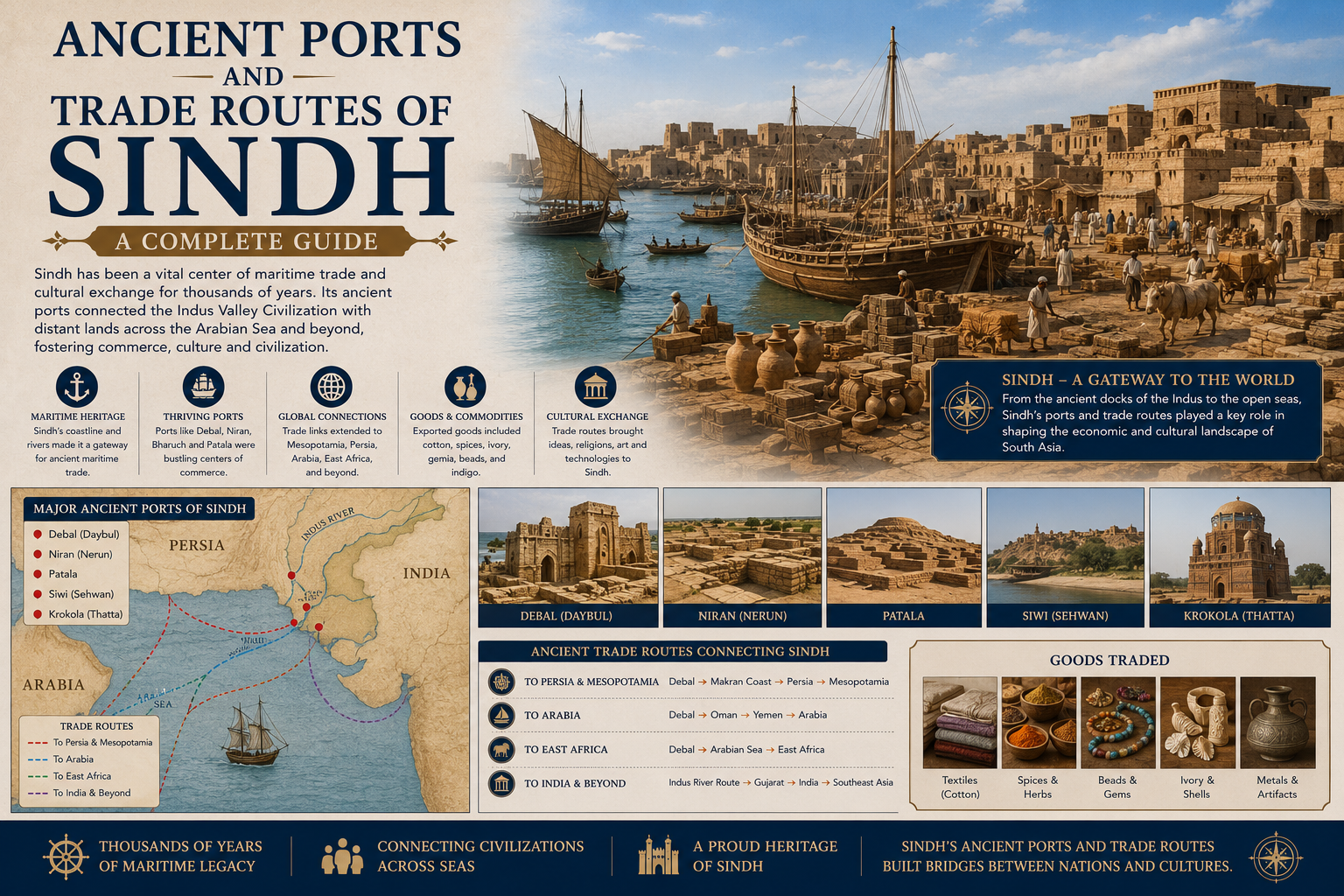
Sindh has been a crossroads of trade for four thousand years. The Indus carried goods from the mountains to the sea. Ships sailed from its delta to Mesopotamia arabia and East Africa. Caravans crossed the deserts to Central Asia. Great ports rose at the river mouth and fell as the channels shifted. This guide covers the ancient ports and trade routes of Sindh. It explains the sea trade the river traffic and the caravan roads.
This guide offers a general overview. Dates and locations for the earliest ports remain debated.
Quick answer: Sindh traded by sea, river and caravan for four thousand years. The Indus Valley cities exchanged goods with Mesopotamia around 2500 BCE. Classical sources name a delta port called Barbarikon. Debal was the great early Islamic port. Many scholars identify it with Bhambore. Thatta later became a major trading city. Shikarpur grew rich on the caravan route through the Bolan Pass. The ports declined as the Indus shifted course.
Why Sindh became a crossroads
The Indus made Sindh a trading region. The river runs from the mountains to the Arabian Sea. It carried goods and people for millennia. This natural highway shaped the whole economy of the region.
The delta opened onto the sea. Ships could reach the ocean trade routes from the river mouth. Arabia the Gulf and East Africa all lay within reach. This access made the ports of Sindh valuable.
The land routes ran north and west. Caravans crossed the passes towards Central Asia. Others travelled east into Gujarat and Rajasthan. Sindh lay at the meeting point of these roads.
Indus Valley trade
The Bronze Age cities traded widely. Mohenjo daro and its neighbours exchanged goods across a huge area. Their seals and beads have been found far afield. This reach is remarkable for the period.
Mesopotamia was a major partner. Texts from that region mention trade with a land called Meluhha. Many scholars identify Meluhha with the Indus region. Carnelian beads and other goods travelled west.
The cities traded in fine materials. Craftsmen worked carnelian, lapis lazuli, shell and copper. They produced beads, ornaments and tools. Standard weights suggest a regulated system. This organisation points to sophisticated commerce.
Classical ports Indus Delta
Greek sources describe the delta. Alexander sailed down the Indus in 325 BCE. His fleet reached the sea. Greek writers recorded the coast and its harbours.
Barbarikon served the Roman trade. A first century sailing guide names this delta port. Ships carried goods between Egypt and the Indus mouth. Frankincense, glass and coral came in. Textiles, indigo and precious stones went out.
The exact site remains uncertain. Scholars have proposed several locations for Barbarikon. Some have linked it to the mound at Bhambore. The shifting delta has hidden much of the evidence.
Debal and the early Islamic ports
Debal was the great early port. It handled the sea trade of Sindh in the early Islamic period. Ships from Arabia and the Gulf called there. It was the point of entry to the region.
Many scholars identify Debal with Bhambore. Excavations at that site revealed a walled port city. Its own dedicated guide covers Bhambore in more detail. The identification is widely held but not certain.
The port fell in 712. Muhammad bin Qasim took Debal in that year. The campaign brought Sindh under Umayyad rule. The port continued to trade for centuries afterwards.
Mansura became an inland centre. The Habbari emirs ruled from this city. It served as a hub for goods moving up the river. Trade with the wider Islamic world flourished in this period.
Thatta and the medieval trade
Thatta grew into a great trading city. It served as a capital under several dynasties. Its position near the delta made it valuable. Its own dedicated guide covers the town.
The city traded across the ocean. Merchants dealt in textiles, indigo and other goods. Thatta became famous for its cotton cloth. European traders sought it out in the 17th century.
The city declined with the river. The Indus shifted course over time. The channels near Thatta silted up. Ships could no longer reach the city easily. Karachi later rose in its place.
Caravan routes
Caravans crossed the northern passes. Routes ran through the Bolan Pass towards Central Asia. Goods travelled between Sindh and the great cities of the north. This overland trade was as important as the sea.
Shikarpur grew rich on this trade. The town became a banking and trading hub. Its merchants dealt with markets across Central Asia. Its own dedicated guide covers that history. Its bankers financed trade over vast distances.
Other routes ran east and south. Caravans crossed the Thar towards Rajasthan and Gujarat. Coastal roads linked the delta to the ports of the west. These routes carried goods for centuries.
Shifting river and the decline
The Indus never stayed still. The river changed course many times. Channels silted up and new ones opened. This restlessness shaped the fate of every port.
Ports rose and fell with the water. A city thrived while the channel served it. It declined when the river moved away. Bhambore and Thatta both suffered this fate.
Karachi rose as the others fell. The port grew in the 18th and 19th centuries. The British developed it further. It became the great port of the region. The older harbours were left to the sand.
Frequently asked questions
What were the main ancient ports of Sindh? Several great ports served Sindh over four thousand years. Classical sources name a delta port called Barbarikon. Debal was the major port of the early Islamic period. Many scholars identify it with the site at Bhambore. Thatta became a great trading city in the medieval period. Karachi rose later and became the principal port of the region. Each declined as the channels of the Indus shifted.
Where was the ancient port of Debal? Debal was the main sea port of Sindh in the early Islamic period. Muhammad bin Qasim took it in 712 CE. Many scholars identify it with the archaeological site at Bhambore. That site lies around sixty five kilometres east of Karachi. Excavations there revealed a walled port city with an anchorage. The identification is widely held but not universally accepted.
Did the Indus Valley Civilisation trade with other regions? The Indus Valley Civilisation traded across a very wide area. Its seals and beads have been found far from the Indus. Mesopotamian texts mention trade with a land called Meluhha. Many scholars identify Meluhha with the Indus region. Craftsmen worked carnelian, lapis lazuli, shell and copper. Standard weights suggest a regulated commercial system.
What goods did Sindh trade in ancient times? Sindh traded a wide range of goods over the centuries. The Bronze Age cities exported carnelian beads, ornaments and worked shell. Classical ports handled textiles, indigo and precious stones. They imported frankincense, glass and coral. Thatta later became famous for its cotton cloth. European traders sought that fabric in the 17th century. Caravans carried goods overland to Central Asia.
Why did the ancient ports of Sindh decline? The ports declined mainly because the Indus changed course. The river shifted its channels many times. Harbours silted up as the water moved away. Ships could no longer reach the cities. Bhambore and Thatta both declined for this reason. Karachi rose in their place and became the great port of the region.
Crossroads of the Indus
Sindh has been a meeting point of trade for four thousand years. Its Bronze Age cities sent beads to Mesopotamia. Its delta ports served Roman and Arab ships. Its caravans crossed the passes to Central Asia. Its bankers financed trade across half a continent. The river carried it all to the sea.
The ports themselves have mostly vanished. The Indus buried some and abandoned others. You can still walk the walls of Bhambore. You can still see the tombs of Thatta. You can still visit the bazaars of Shikarpur. The dedicated guides cover each of these places. They are what remains of a trading world that lasted four thousand years.