Aiwan e Sadr Islamabad: A Look at the Presidency Building
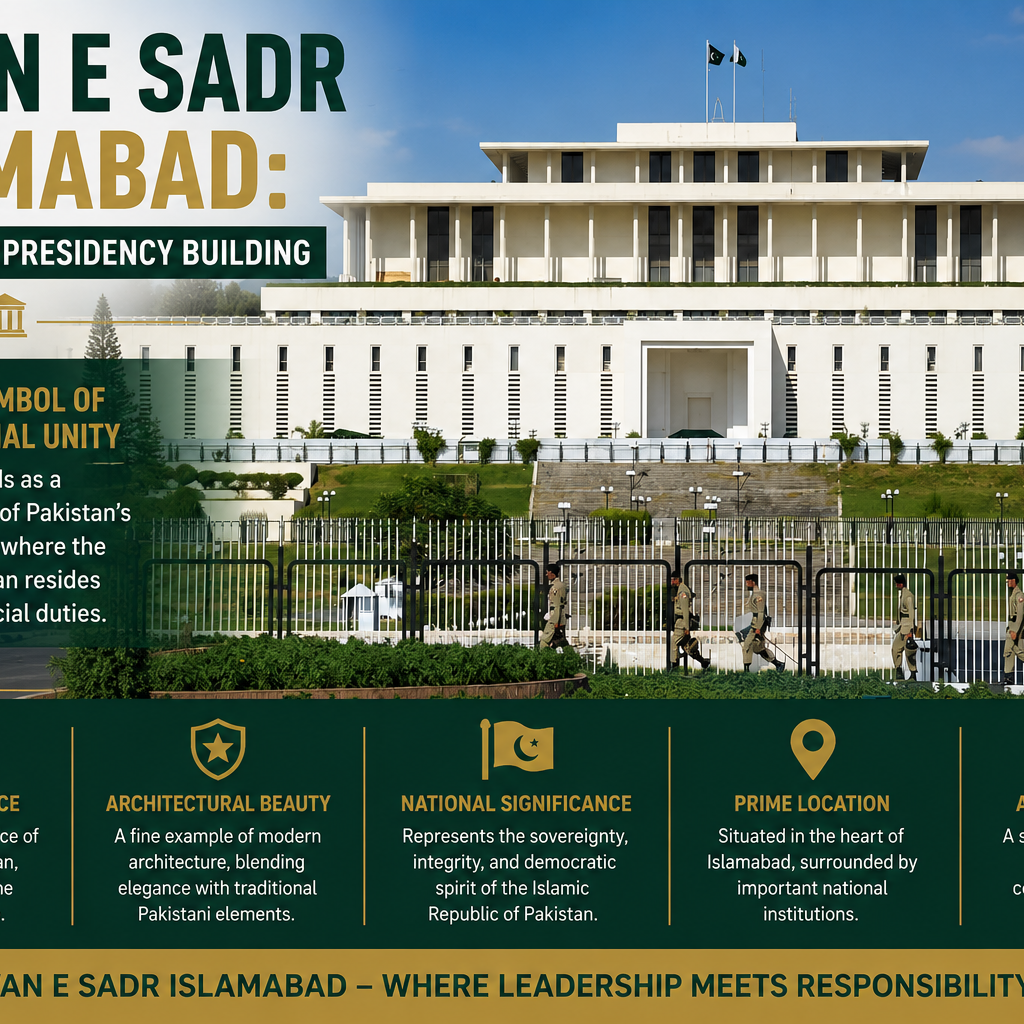
Aiwan e Sadr, the official presidency of Pakistan, is situated on Constitution Avenue in the Red Zone of Islamabad. With its white, step pyramid form set among the country's main government buildings, it is one of the most significant structures in the capital, though its role keeps it largely out of public view.
This article explains what Aiwan e Sadr is, its history, its architecture and the area around it. The focus here is on the building itself, its design and its setting within Islamabad's administrative heart, written for anyone getting to know the capital and its landmarks.
Aiwan e Sadr
Aiwan e Sadr is the official residence and workplace of the President of Pakistan. The name translates as the President's House or Palace and the building serves as both the home and the principal office of the head of state.
It is situated in the Red Zone of Islamabad, along Constitution Avenue, positioned between the Parliament House and the Pakistan Secretariat. This places it at the centre of the capital's administrative district, among the main institutions of the state. Residences for the presidential staff, known as the President's Colony, sit behind the presidency.
The building was completed in the early 1980s and the first president to take up residence there was Ghulam Ishaq Khan, in 1988. Before Aiwan e Sadr was built, the presidency operated from an older building in Rawalpindi. The move to the purpose built presidency in Islamabad was part of settling the institutions of state into the new capital.
As the seat of the presidency, Aiwan e Sadr is a high security building and it is generally not open to the general public. It hosts state ceremonies, diplomatic receptions and the formal functions of the head of state, making it one of the most important buildings in the country.
Quick answer: Aiwan e Sadr is the official residence and office of President of Pakistan. It is located on Constitution Avenue in Islamabad's Red Zone between the Parliament House and the Pakistan Secretariat. Its first resident was President Ghulam Ishaq Khan in 1988.
History of Aiwan e Sadr
The history of Aiwan e Sadr is tied to the development of Islamabad as the national capital. Before it was built, the president of Pakistan lived and worked in an older building in Rawalpindi, a colonial era structure that served as the presidency for a time. That building later became the campus of a university.
As Islamabad grew into the capital, the country needed a permanent, purpose built home for the presidency, positioned among the other institutions of state. Construction of Aiwan e Sadr began in 1970 and took around eleven years to complete. The building was inaugurated in the 1980s and Ghulam Ishaq Khan became its first resident in 1988.
Over the years, the presidency has been the setting for many important moments in the country's life. It has hosted heads of state, diplomatic events and the formal ceremonies of government, including oath taking ceremonies held in its grand halls. Its position at the centre of the administrative district has made it a fixture of national life.
In more recent years, the building has taken on a notable environmental distinction. Under a Green Presidency Initiative, steps were taken to reduce its energy use and shift it to renewable energy, including a solar system. In 2022, the presidency received an international energy management certification, reported as making it the world's first such presidency to achieve this standard. This marked a new chapter for the historic building.
The architecture of Aiwan e Sadr
The architecture of Aiwan e Sadr is one of its most distinctive features. The building takes the form of a modern step pyramid, finished in white tones, in keeping with the style of many government buildings in Islamabad.
This step pyramid design gives the presidency a dignified, monumental form that is situated out along Constitution Avenue. The white exterior connects it visually to the other main state buildings nearby which share a similar clean, light appearance. The design blends modern architecture with a sense of the formality and permanence appropriate to the seat of the head of state.
The building is known for the contrast between its exterior and its interior. Though the exterior boasts pristine white lines, the interior is lavishly decorated, and huge halls are reserved for rituals and receptions. The primary halls have names inspired by the founders of the nation, thus further enhancing the ceremonious aspect of the structure. These spaces have hosted many state functions over the years.
The grounds around the presidency draw on traditional Mughal garden design, with manicured lawns, trees, flowers and fountains arranged in structured, formal spaces. White water fountains punctuate the lawns, serving both a decorative and a ceremonial purpose. The gardens extend to the rear of the building and footpaths run through them which have allowed visitor movement during the occasional public openings. This combination of a modern step pyramid structure with formal Mughal inspired gardens gives Aiwan e Sadr its particular character.
Role of Aiwan e Sadr
Aiwan e Sadr serves as both the residence and the principal workplace of the President of Pakistan. It combines the functions of a home for the head of state with the offices and facilities needed for the work of the presidency.
The building includes administrative offices for the presidential staff, residential quarters and the grand halls used for state ceremonies and diplomatic receptions. The administrative head of Aiwan e Sadr is the principal secretary to the president. The complex is designed to support the formal and ceremonial functions of the head of state, from hosting visiting dignitaries to holding official events.
As a result of the nature of the presidency, it is always a secure place, and the entry to the place is restricted. The general public does not have the privilege to visit the place because of its confidential nature. However, there have been some rare instances where the presidency was open to the general public so that the visitors could get a glimpse of the place.
Green Presidency Initiative
One of the more recent and distinctive chapters in the story of Aiwan e Sadr is its shift towards renewable energy. Under a Green Presidency Initiative launched in 2018, steps were taken to reduce the building's energy consumption and move it onto clean energy sources.
The centrepiece of the effort was the installation of a solar power system at the presidency, along with energy saving measures throughout the building. The aim was to cut the building's reliance on conventional power and lower its environmental impact, turning one of the country's most prominent buildings into an example of energy efficiency.
The results were recognised with international certification. In 2022, the presidency received an energy management certification that was reported as making it the world's first such presidency to achieve the standard. The building also received recognition from a green building body, with its electricity needs met by an in house solar system. The reported savings were significant, framed in terms of reduced energy use and lower greenhouse gas emissions.
This initiative added a modern, forward looking dimension to a building otherwise defined by its formal, ceremonial role. It showed how a historic institutional building could be adapted to newer standards of energy use and it became a point of distinction for the presidency in recent years.
Places near Aiwan e Sadr
Aiwan e Sadr is situated in the Red Zone of Islamabad, the secure administrative district at the centre of the capital. This central setting places it among the most important landmarks of the city, surrounded by the main institutions of the state.
Its closest neighbours are the other key government buildings. The Parliament House is situated on one side, with a terraced lawn between them and the Pakistan Secretariat lies on the other. The Prime Minister's Office and the Supreme Court of Pakistan building are also nearby, all arranged along Constitution Avenue and the city's planned administrative axis. Together, these buildings form the cluster of state institutions at the heart of Islamabad.
The National Library of Pakistan and other important institutions are located in the vicinity of the Red Zone. The Diplomatic Enclave which houses many embassies and high commissions, is situated nearby as well, in its own secure zone. This concentration of government and diplomatic buildings makes the area the centre of national administration.
Beyond the immediate district, Aiwan e Sadr connects to the wider capital through Constitution Avenue and Islamabad's road network. The central sectors of the city, with their markets, offices, hospitals and services, are within reach and landmarks such as the Faisal Mosque and the Pakistan Monument are part of the same central area of the capital.
For anyone understanding the geography of Islamabad, Aiwan e Sadr is one of the buildings that defines the administrative heart of the city. The sectors around this central district are among the capital's most established and prominent and proximity to the government and diplomatic areas shapes the character of central Islamabad.
Why Aiwan e Sadr matters to Islamabad
Beyond its function, Aiwan e Sadr holds a significant place in the identity of Islamabad. As the seat of the presidency, it is one of the buildings most associated with the capital's role as the centre of national government.
For the city, Aiwan e Sadr is part of the cluster of state institutions that gives Islamabad its purpose as the capital. Alongside the parliament, the courts and the diplomatic missions, the presidency helps make the Red Zone the administrative heart of the country. Landmarks of this kind define how the city is understood and add to its standing as the national capital.
The building also carries symbolic weight by representing the office of the head of state and the institutions of the country. Its distinctive step pyramid design, formal gardens and central position make it a recognisable landmark of the capital. Its recent environmental distinction has added a modern dimension to its long standing role. For anyone getting to know Islamabad, Aiwan e Sadr is one of the important buildings that shape the character of the capital.
Frequently asked questions
Where is Aiwan e Sadr located? Aiwan e Sadr is on Constitution Avenue in the Red Zone of Islamabad, positioned between the Parliament House and the Pakistan Secretariat. It is situated at the centre of the capital's administrative district, among the main institutions of the state.
What is Aiwan e Sadr used for? It is the official residence and principal workplace of the President of Pakistan. The building combines residential quarters with offices for the presidential staff and grand halls used for state ceremonies and diplomatic receptions.
When was Aiwan e Sadr built? Construction began in 1970 and took around eleven years to complete. The building was inaugurated in the 1980s and President Ghulam Ishaq Khan became its first resident in 1988.
What is the architecture of Aiwan e Sadr like? The building takes the form of a modern step pyramid, finished in white tones like many government buildings in Islamabad. Its richly decorated interior contrasts with its clean exterior and it is surrounded by formal, Mughal inspired gardens with lawns and fountains.
Can the public visit Aiwan e Sadr? The presidency is a secure building and is generally not open to the general public because of its sensitive role. On a few rare occasions, it has been opened to the public for limited periods, allowing people to see the building and its grounds.
What places are near Aiwan e Sadr? The Parliament House, the Pakistan Secretariat, the Prime Minister's Office and the Supreme Court are all nearby in the Red Zone, along with the National Library and the Diplomatic Enclave. The building connects to the wider capital via Constitution Avenue.
Aiwan e Sadr is one of the most significant buildings in Islamabad. As the official presidency of Pakistan, it is situated at the centre of the capital's administrative district, among the main institutions of the state on Constitution Avenue.
Its modern step pyramid design, its richly decorated halls and its formal Mughal inspired gardens give the building a distinctive character and its recent shift to renewable energy has added a modern chapter to its history. Though its role as the residence and workplace of the head of state keeps it largely out of public view, Aiwan e Sadr remains one of the defining landmarks of the capital. For anyone getting to know Islamabad, it is one of the important buildings that make the city the centre of national government and a key part of the administrative heart that gives the capital its purpose.