Aabpara Market Islamabad: A Guide to the Historic Market
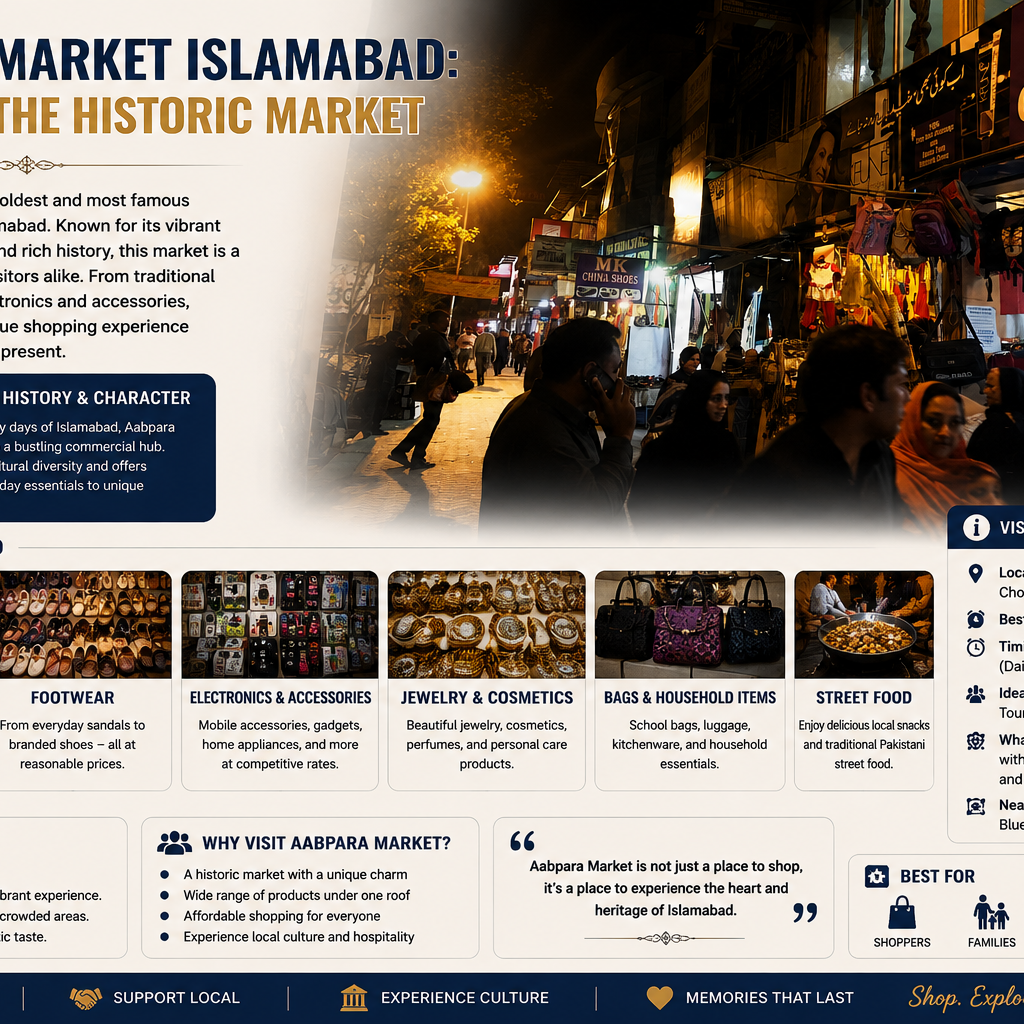
In the heart of Islamabad, in Sector G 6, is situated the oldest market in the capital. Aabpara Market has been trading since the earliest days of the city and it remains one of the busiest and most affordable shopping areas in Islamabad, where you can find almost anything, from groceries and household goods to clothing, electronics and famous street food. For anyone getting to know the capital, Aabpara offers a glimpse of its history and a taste of its everyday life.
This article explains what Aabpara Market is, its history, what there is to shop and eat and how it fits into the character of the capital. Written for anyone getting to know Islamabad, it covers both the market itself and its place as a historic part of the city.
Aabpara Market
Aabpara Market is a large commercial market at the south western edge of Sector G 6 in Islamabad, along Khayaban e Suharwardy. It is the oldest market in the capital, built in 1960 during the earliest construction of the city and it remains one of the busiest and most popular shopping areas in Islamabad.
The market is a traditional bazaar, made up largely of small shops and street vendors offering a broad range of goods. It is known as a one stop shop for daily needs, where residents can find almost everything, from fresh produce and groceries to household items, clothing, electronics and more. Its affordability and variety, combined with its central location, have made it a favourite shopping destination for people across the capital.
The Aabpara market is a busy one. It is a market that comes alive with the buzzing of people as well as the energy of a bustling bazaar. This is where one will find haggling at the street stands that sell food and products. Such an aura along with its history makes the Aabpara market unique compared to the modern day malls that dot the capital.
Being the oldest market of the capital, Aabpara has been there since the establishment of the capital. Since then, it has been an important part of the lives of many generations of people of the central sectors. This has made the market what it is today – historic, affordable and varied.
Quick answer: The Aabpara Market is the oldest market of Islamabad, located in Sector G 6 along Khayaban e Suharwardy; established in 1960. A traditional bazaar of small shops and street vendors, it offers groceries, household goods, clothing, electronics and famous street food at affordable prices and remains one of the busiest shopping areas in the capital.
History of Aabpara Market
The history of Aabpara Market goes back to the very founding of Islamabad. When the capital was built from 1960, Sector G 6 was one of the first residential areas developed, with government quarters constructed to house the civil servants and government employees who were moving to the new capital. Many of these early residents came from the government departments being transferred to the new capital and some were from what was then East Pakistan, now Bangladesh.
To serve this early community, a market was built in the area and it became the first proper market of the new capital. This makes Aabpara the oldest market in Islamabad, dating from the very beginning of the city. The first primary school of Islamabad was also established in this area, underlining its role as one of the earliest developed parts of the capital.
The market has a charming and unusual origin for its name. According to the well known account, in 1960 a baby girl was born to a Bengali couple living in the government quarters of the area and she was named Aabpara. As the first child born in the newly built capital, the event was celebrated by the residents and they decided to name the market and the locality after her. Years later, the girl and her family are said to have moved to Bangladesh following the separation of East Pakistan. The area was formerly known as Bagh Bhattan before it took the name Aabpara.
Over the decades, the market has grown alongside the capital, developing from the first market of a new city into the busy, extensive bazaar seen today. It has served generations of residents, particularly those in the surrounding government quarters and central sectors and it has remained a central part of everyday life in the capital. As with many old markets, it has faced challenges of crowding, encroachment and management over the years, but it has kept its role as the historic heart of shopping in the city.
Shopping at Aabpara Market
Shopping is at the heart of Aabpara Market and its greatest strength is the sheer range of goods available in one place, at affordable prices. It is known as a comprehensive market where you can find almost anything for daily life.
The market covers a huge range of goods. Shoppers can find groceries, fresh fruits and vegetables, meat and dry fruits, alongside household items, kitchen utensils, crockery and hardware. Regarding clothing and personal items, there are various stores that sell clothes, shoes and accessories, and also books, stationery, and sports goods. Moreover, electronics and consumer goods are sold here in abundance, turning the market into a place that not only sells essential but also various other items.
Another peculiar aspect of the market is the presence of various repair services. As mentioned above, one of the peculiarities of Aabpara is the presence of a special street or alley devoted to repairing things like blenders and grinders, suitcases, bags, and even umbrellas. Such an attribute adds to the practicality of the market, representing a tradition of repairing that is no longer present in more modern markets.
Affordability is another important characteristic of the market. The prices here are rather affordable and cheaper than those of the surrounding upscale places. Items are available across a range of qualities to suit different budgets and haggling at the street stalls can secure good deals. This combination of variety, affordability and the traditional bargaining culture is what draws shoppers from across the capital to Aabpara.
Street food of Aabpara
Alongside its shopping, Aabpara Market is one of the best places in the capital for street food and traditional eating and this is a big part of its appeal. The market has a long established food scene, with old restaurants and food stalls offering authentic, affordable meals.
The market is known for its street food and traditional dishes. The food stalls and vendors have an array of local foods including the golgappa and other types of street foods, along with grilled meat and other kinds of dishes. Some old restaurants that can be found both in and out of the market provide local dishes at affordable prices. In addition, some of the renowned restaurants have outlets in the market.
Sweets are another draw. Long established sweet shops in the area offer a wide range of traditional sweets, from gulab jamun to a variety of other specialities, popular especially in the cooler months. This blend of street food, traditional restaurants and sweet shops makes Aabpara a destination for eating as well as shopping and it is one of the reasons the market is so loved. Visit to Aabpara is as much about the food as the shopping which offers an authentic taste of the capital's culinary traditions.
Why Aabpara matters to Islamabad
The importance of Aabpara Market goes far beyond the fact that it is an important market place and source for food in Islamabad. The significance of Aabpara Market lies in the fact that it was the first market developed in Islamabad.
For the capital, Aabpara is a piece of living history, the first market of a planned city which has grown alongside Islamabad since its earliest days. It reflects the early urban life of the capital, from the government quarters of its founding to the busy bazaar of today. Its story, including the charming origin of its name, is part of the story of the city itself. As a traditional bazaar, it also preserves a way of shopping, with small shops, street vendors and bargaining, that contrasts with the modern malls of the capital.
Moreover, its central position and low prices make it equally significant. The market fulfills the needs of the people living in central zones and the nearby government zones, offering them inexpensive goods through which they can fulfill their basic needs and helping a considerable number of vendors who trade there. Thus, being a market in addition to the historical significance of the market gives it further importance.
It is through Aabpara that one gets to understand the history and the daily life of Islamabad. Its location in the central G 6 sector, close to the heart of the city and its role as the oldest and one of the busiest markets, make it a defining part of the capital. The central sectors around Aabpara benefit from having a historic, affordable market at their heart and the market is one of the features that gives this part of the capital its character.
Visiting Aabpara Market
Aabpara Market is easy to reach and one of the most characterful places to explore in Islamabad. It is situated in Sector G 6, along Khayaban e Suharwardy, in a central location close to the heart of the capital and is easily reached from across the twin cities.
The market is accessible by car, taxi or ride hailing service and it is well connected by road, close to major routes and near central areas such as Zero Point. Public transport, including feeder bus routes linking to the Metro Bus system, also serves the area. A few practical points help: parking can be challenging, given how busy the market is, so arriving early or being prepared to wait is wise and the area can be crowded and lively which is part of its character.
The best way to experience Aabpara is on foot, exploring the shops, stalls and lanes, including the repair street and the food stalls. Given its size and variety, it rewards those who take the time to wander through it. As with any busy market, it is sensible to keep belongings secure and be aware of your surroundings, though the market is generally safe for shoppers. The market can be noisy and crowded, especially at peak times, so those seeking a calmer visit may prefer quieter hours.
The cooler months are the most pleasant time to explore the market and enjoy its street food, particularly the traditional sweets and hot dishes that are especially good in winter. Whether you visit Aabpara to shop for daily goods, to hunt for bargains, to get something repaired or to enjoy its famous street food, it offers an authentic and rewarding experience of the capital's oldest market.
Quick answer: Aabpara Market is in Sector G 6 along Khayaban e Suharwardy, reachable by car, taxi, ride hailing service or public transport, in a central location. It is best explored on foot. Parking can be challenging and the market crowded, so arriving early helps and the cooler months are ideal for enjoying its street food.
Frequently asked questions
Where is Aabpara Market located? Aabpara Market is at the south western edge of Sector G 6 in Islamabad, along Khayaban e Suharwardy, in a central location close to the heart of the capital. It is easily reached from across the twin cities.
Why is it called Aabpara? According to the well known account, the market is named after a baby girl called Aabpara, born to a Bengali couple in the area in 1960. As the first child born in the newly built capital, the event was celebrated and the market and locality were named after her. The area was formerly known as Bagh Bhattan.
How old is Aabpara Market? Aabpara is the oldest market in Islamabad, built in 1960 during the earliest construction of the capital. It was the first proper market of the new city and has grown alongside Islamabad ever since.
What can you buy at Aabpara Market? The market offers a huge range of goods, including groceries, fruits and vegetables, meat, dry fruits, household items, kitchen utensils, hardware, clothing, shoes, books, stationery and electronics. It is also known for a street of repair shops that can fix almost anything.
Is Aabpara Market good for food? Yes. Aabpara is one of the best places in the capital for street food and traditional eating, with food stalls, old restaurants and famous eateries serving local dishes, kebabs and snacks, along with long established sweet shops offering traditional sweets.
Is Aabpara Market affordable? Yes. Prices at Aabpara are generally competitive and lower than in many surrounding markets which makes it a favourite for bargain hunters. Items are available across a range of qualities and haggling at the street stalls can secure good deals.
Aabpara Market is one of the defining and most historic parts of Islamabad, the oldest market in the capital which has grown alongside the city since its founding in 1960. As a traditional bazaar of small shops, street vendors and food stalls, it offers a huge range of goods at affordable prices, from groceries and household items to clothing, electronics and famous street food.
As you learns about Islamabad, Aabpara gives an insight into the past as well as the present of the capital city through its interesting origin name as well as its current status as a bustling, cheap marketplace situated right in the heart of the central sectors of the city. This market is special due to the combination of its history, diversity, cheapness and its traditional nature; a stark contrast to the city’s modern shopping centers. Irrespective of whether one visits Aabpara to buy provisions, look for bargains, fix something or simply taste its delicious street food, it continues to be an important marketplace of Islamabad.